
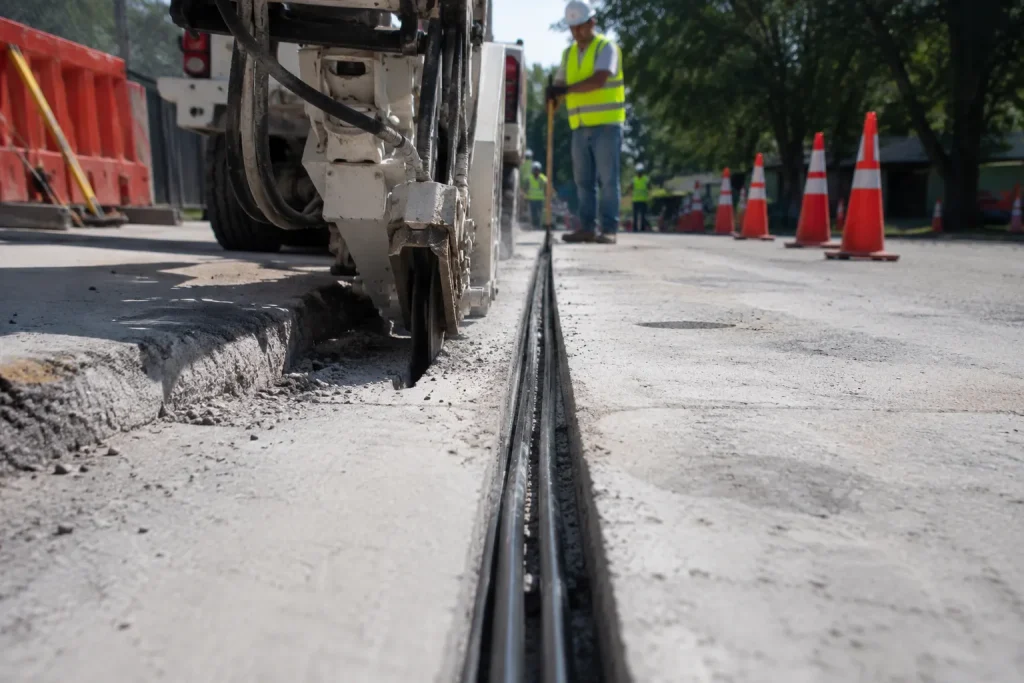
Microtrenching has become one of the fastest methods for deploying underground utilities. Cities and contractors use this approach to install fiber optics, power cables, and communication lines with minimal disruption. The growing demand for high-speed internet and smart infrastructure has increased interest in Microtrenching across North America and Europe.
Unlike traditional excavation, this method creates narrow cuts that usually measure between 0.75 and 2 inches wide. Depths often range from 8 to 24 inches, depending on project requirements. Smaller trenches reduce labor, shorten project timelines, and lower restoration costs.
Our experience reviewing utility projects shows that municipalities prefer methods that reduce traffic delays. Industry experts report that Microtrenching can lower installation expenses by 30% to 50% compared with conventional trenching methods. Faster deployment also helps service providers connect customers sooner.
Modern utility projects require speed, accuracy, and minimal environmental impact. Microtrenching addresses these needs while maintaining safety and improving productivity. This approach has transformed how contractors deliver infrastructure projects in urban and suburban environments.
Why Microtrenching Improves Installation Speed
Narrow Trenches Reduce Construction Time
Microtrenching allows contractors to cut precise channels instead of removing large sections of pavement. Specialized saws create narrow openings that require less excavation and fewer workers. A traditional trench may require several feet of width, while a microtrench often stays below 2 inches.
Industry data shows crews can install between 1,000 and 3,000 feet of conduit daily. Conventional methods typically complete 300 to 800 feet per day. Faster installation means shorter road closures and lower operational costs.
Experienced utility contractors confirm that reduced excavation simplifies cleanup and restoration. Smaller cuts also decrease the amount of debris generated during construction. These advantages help projects remain on schedule.
Transportation agencies increasingly support Microtrenching because it minimizes disruptions. Residents and businesses benefit from fewer delays and quicker access to upgraded services.
Lower Restoration Requirements
Restoring pavement represents a major expense in utility construction. Traditional trenches require extensive resurfacing and patching. Microtrenching limits surface damage and reduces restoration work significantly.
Many projects use polymer grout or specialized sealants to secure conduits. These materials provide durability and maintain road integrity. Proper sealing also protects cables from moisture and environmental damage.
Field engineers often report that restoration costs decline by 40% or more when using Microtrenching. Reduced material requirements further improve project efficiency. These savings allow utility companies to allocate resources to additional infrastructure improvements.
Applications of Microtrenching in Modern Infrastructure
Fiber Optic Network Expansion
Telecommunication providers rely heavily on Microtrenching to expand broadband networks. The method supports rapid deployment in densely populated areas. Fiber optic installations require precise pathways that minimize disruptions.
According to industry estimates, global internet traffic exceeded 5.4 zettabytes in 2024. Rising demand for data requires faster network expansion. Microtrenching helps providers meet these requirements efficiently.
Our analysis of urban broadband projects shows that cities favor methods that avoid lengthy road closures. Residents appreciate faster installations and fewer inconveniences. Businesses also benefit from improved connectivity.
Engineers recommend Microtrenching for areas with existing infrastructure because narrow cuts reduce interference with underground assets. This advantage improves safety and project reliability.
Smart City and Utility Projects
Smart cities depend on interconnected infrastructure systems. Sensors, power cables, and communication lines require efficient installation methods. Microtrenching supports these requirements without major excavation.
Municipal planners increasingly integrate smart traffic systems and environmental monitoring networks. These technologies require dependable underground connections. Fast installation accelerates project completion.
Energy providers also use Microtrenching for low-voltage cable deployment. Reduced excavation lowers environmental impact and preserves existing landscapes. Urban communities benefit from cleaner and quieter construction activities.
Industry experts emphasize that flexible deployment methods will remain essential as cities continue expanding digital infrastructure. Microtrenching provides a practical solution for these evolving demands.
Benefits of Microtrenching Compared With Traditional Trenching
Key Advantages
Microtrenching offers several important benefits:
- Installation speeds of up to 3,000 feet daily.
- Restoration costs reduced by 30% to 50%.
- Narrow trenches measuring 0.75 to 2 inches.
- Lower labor requirements.
- Reduced traffic disruptions.
- Less construction waste.
- Faster broadband deployment.
- Improved urban project efficiency.
Comparison Table
| Feature | Microtrenching | Traditional Trenching |
|---|---|---|
| Typical Width | 0.75–2 inches | 12–36 inches |
| Daily Installation | 1,000–3,000 feet | 300–800 feet |
| Pavement Damage | Minimal | Extensive |
| Restoration Costs | Lower by 30–50% | Higher |
| Traffic Disruption | Limited | Significant |
| Labor Requirements | Reduced | Higher |
| Project Completion | Faster | Slower |
Expert Insights
Civil engineers involved in telecommunications projects highlight the importance of minimizing disruptions. Smaller trenches improve public acceptance and reduce complaints from nearby businesses.
Based on real project observations, crews spend less time on site and complete restoration faster. These efficiencies contribute to lower overall costs and improved customer satisfaction.
Contractors also note that specialized cutting equipment delivers greater precision. Accurate trench dimensions improve cable protection and reduce maintenance concerns. These advantages make Microtrenching a preferred method for modern utility installations. Start your journey with our guide to Innovative Materials Used in Underwater Construction.
Conclusion
Microtrenching has changed the way utility infrastructure is installed. Its narrow trenches, faster deployment rates, and reduced restoration needs make it highly effective. Contractors can install up to 3,000 feet of conduit daily while lowering costs by as much as 50%.
The method supports fiber optic expansion, smart city initiatives, and power distribution projects. Reduced traffic disruptions and smaller environmental impacts provide additional advantages. Industry experts continue to recommend Microtrenching for urban and suburban developments.
As demand for digital connectivity increases, efficient installation techniques become more important. Microtrenching delivers the speed, precision, and reliability required for modern infrastructure projects. Its benefits make it a valuable solution for the future of utility construction.